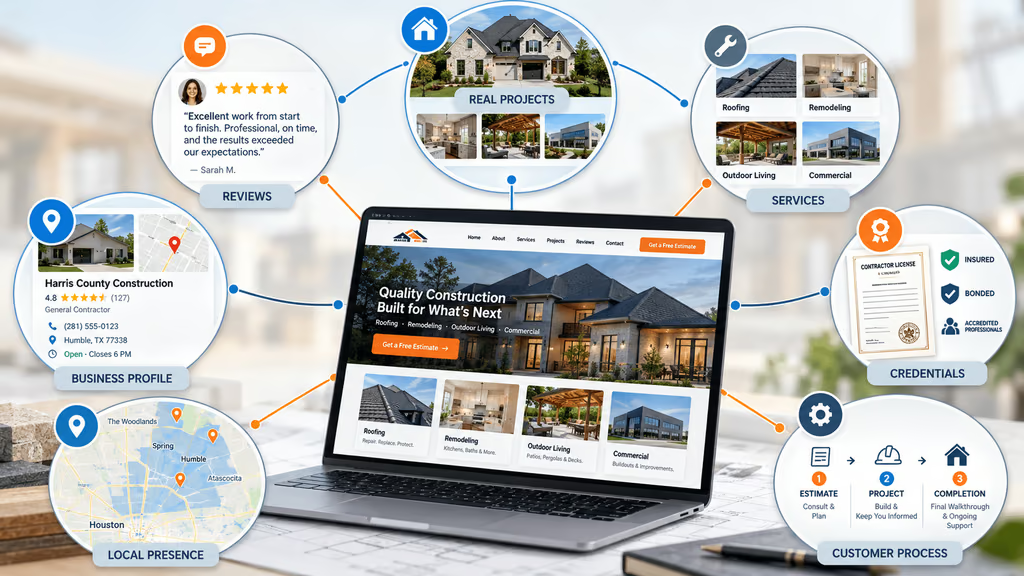
Construction SEO Trust Signals
This guide is built around one simple idea: real-world proof supports online visibility.
A construction company can have a good website, a verified Google Business Profile, years of experience, and dozens of completed projects and still look surprisingly unclear online.
The problem is often not a lack of information.
It is a lack of corroborating information.
Your website says you are a roofing contractor. Your Google Business Profile emphasizes general construction. Your reviews mostly mention repairs. Your project gallery does not identify where the work was completed. Your service pages sound similar to hundreds of other contractor websites.
A prospective customer may eventually figure out what you do.
Google has to figure it out too.
That is where construction SEO trust signals become important.
Construction SEO trust signals are the visible pieces of evidence that help customers and search engines understand who a contractor is, what work the company performs, where it works, and whether there is credible evidence behind those claims.
No single trust signal guarantees rankings.
The strength comes when multiple signals reinforce the same story.
How Contractors Turn Real-World Proof into Stronger Local SEO
Construction companies have something many businesses do not.
They can usually show the work.
A completed roof, renovated kitchen, commercial build-out, HVAC installation, concrete project, or home addition creates real-world evidence that can support the claims made on a website.
That evidence does not have to live in one place.
A single completed project might eventually support:
- A project page
- A service page
- A Google Business Profile photo
- A customer review
- A service-area reference
- A social media post
- A case study
- An internal link to a related service
- A future answer to a customer question
This is where contractor SEO becomes more interesting than simply adding another keyword to a page.
A company says it performs roof replacements;
The website has a substantive roof replacement page. Project photos show actual completed roofs. Project descriptions identify communities where the company actually works. Manufacturer credentials support the products being installed, and real customers discuss roof replacements in reviews.
Google Business Profile services support that part of the business.
Now the business is no longer making one isolated claim. It is creating a pattern of real-world evidence.
That pattern is what makes construction trust signals useful.
Quick Answer: What Are the Most Important Construction SEO Trust Signals?
- Seven signals deserve particular attention:
- A clear and identifiable construction business
- Reviews that describe real customer experiences
- Substantive service and project-type pages
- Website and Google Business Profile alignment
- Real project photos and completed-work evidence
- Local and industry authority signals
- A visible customer process, credentials, and business practices
Think of them as corroborating evidence.
- Your website makes a claim.
- Your Google Business Profile supports it.
- Your reviews confirm it.
- Your project photos demonstrate it.
- Your service areas provide geographic context.
Credentials and outside sources help establish that the company is connected to the industry and market it claims to serve.
The customer process helps show that there is a real operating business behind the website. That combination creates a much stronger picture than any one SEO tactic.
7 Construction SEO Trust Signals Worth Strengthening
Construction SEO trust signals are the visible pieces of evidence that help customers and search engines understand who a contractor is, what work the company performs, where it works, and whether there is credible evidence behind those claims.
1. A Clear and Identifiable Construction Business
Construction websites sometimes make it surprisingly difficult to determine who is actually behind the company.
There may be a logo, a phone number, and a list of services but very little identifiable business information.
Customers look for more.
Search engines also need enough consistent information to connect the website with a recognizable real-world business.
Useful identity signals can include:
- Consistent company name
- Established business address or clearly described service area
- Consistent phone number
- Owner or leadership information
- Years in business when verifiable
- Contractor or trade credentials when applicable
- Professional memberships
- Insurance or bonding information where appropriate
- An About page that identifies the actual company behind the work
A contractor should not feel anonymous online.
For many construction companies, the owner, estimator, project manager, or field team is part of the reason customers choose the business.
Show them.
Consultant’s Read
A stock photograph of somebody in a hard hat does very little to establish who your company is. A real owner, real crew, real truck, real office, and real project do considerably more.
The goal is not to stuff credentials onto every page. It is to provide enough consistent information that customers and search engines can connect the website with an identifiable business doing real work.
2. Reviews That Describe Real Customer Experiences
A five-star rating is helpful. The words inside the reviews can be even more revealing.
Compare:
Great company. Highly recommended.
with a review describing:
- A roof replacement after storm damage
- Communication with the project manager
- Cleanup after the work
- Help selecting materials
- Work completed in Kingwood
- A kitchen remodel
- Commercial build-out work
- Foundation repair
- An emergency plumbing or HVAC response
Those reviews contain context. They provide evidence about the services customers actually hired the company to perform. They can also reinforce geography, service quality, communication, timeliness, and project type.
A construction business with dozens or hundreds of detailed reviews begins to build a visible history of customer experience.
That history can appear across:
- Google reviews
- Website testimonials
- Project case studies
- Facebook recommendations
- Relevant industry platforms
- Supplier or manufacturer profiles
- Local business directories
The important point is not to manufacture keywords inside reviews. It is to encourage genuine customers to describe their actual experience in their own words.
One Review Is a Claim. A Pattern Becomes Evidence.
One customer mentioning a bathroom renovation is useful.
Multiple customers discussing bathroom renovations, accompanied by a substantive bathroom remodeling page and photographs of completed projects, tells a much clearer story.
That is signal alignment.
3. Substantive Service and Project-Type Pages
One of the easiest ways for a construction company to look generic is to use essentially the same thin page for every service.
Consider a roofing page that says:
“We provide professional roofing services using quality materials and excellent workmanship. Contact us today for a free estimate.”
That could describe almost any roofing contractor in America.
A substantive service page might explain:
- Types of projects the company handles
- Materials commonly used
- Repair versus replacement considerations
- What an inspection includes
- What happens during an estimate
- Typical project stages
- Warranty considerations
- Permitting where relevant
- Common problems the contractor encounters
- Service-area considerations
- Questions customers should ask before hiring
- Photographs or examples of completed work
- Insight from the contractor
This is not about making every service page 2,000 words long.
It is about giving the page enough substance to demonstrate that the company understands the work it claims to perform.
Generic Contractor Content Creates Generic Signals
The construction industry is filled with templated websites. The company name changes, the city changes, the service changes. The paragraphs barely change.
Google does not need another page explaining that a roof protects a home from the elements. A homeowner probably doesn’t either.
Useful contractor content answers the questions that come up before someone signs a contract.
It can also connect service claims with actual projects, actual service areas, and the process customers will experience after they make contact.
4. Website and Google Business Profile Alignment
A construction company’s website and Google Business Profile should not appear to describe two different businesses. For companies that need deeper help with profile structure and upkeep, see our Google Business Profile Management service.
Compare the information across both.
- Do the primary services agree?
- Do the service areas make sense?
- Do the categories selected in Google Business Profile reflect what the company actually does?
- Does the website prominently support those same services?
- Are the business name, phone number, address, and other core information consistent?
- Are important services buried on one platform but emphasized on another?
Consider a contractor whose Google Business Profile primarily presents the company as a roofing contractor while the website homepage positions it as a broad remodeling company.
Neither description may be wrong. But the relationship between them may be unclear.
The objective is not perfect word-for-word duplication. It is business alignment.
The major signals should reinforce a recognizable picture of what the company does.
Service-Area Contractors Need Extra Clarity
This is especially important for contractors operating as service-area businesses.
A construction company may work from one location while serving Kingwood, Humble, Atascocita, and other parts of Greater Houston.
That does not mean every nearby city needs a nearly identical page.
It does mean the website should provide credible evidence of where the company actually works.
That evidence may include:
- Service-area pages where justified
- Project examples from those communities
- Customer reviews mentioning locations
- Geographic information within relevant service pages
- Consistent service areas within Google Business Profile
- Local photographs and project references
The geography should reflect the real business, not a list of every city within driving distance.
This is one reason Local SEO Signal Alignment matters. Your website, Google Business Profile, services, locations, reviews, and supporting evidence should reinforce roughly the same picture of the business.
5. Real Project Photos and Completed Work Evidence
Construction companies have an advantage many professional-service businesses do not.
The work can usually be photographed.
Use that advantage.
Real project photography can establish several things at once:
- The company performs the work it describes
- The contractor works on particular types of properties
- The company uses particular materials or techniques
- The company serves identifiable communities
- The business has an ongoing history of completed projects
Before and after images can be particularly useful when they genuinely help explain the work. But a gallery filled with unlabeled photographs leaves much of that value unused.
Instead of:
Recent Project
consider:
Standing-seam metal roof replacement on a residential property in northeast Harris County.
Or:
Kitchen renovation including new cabinetry, countertops, lighting, flooring, and layout changes.
You don’t need to publish a customer’s exact address. You do need enough context for the photograph to mean something.
Turn Projects into Evidence
A strong construction project page might include:
- Type of project
- General location
- Original problem or goal
- Scope of work
- Materials used
- Challenges encountered
- Photographs
- Finished result
- Related service page
That single project can support service expertise, local relevance, internal linking, customer confidence, and the larger story being presented across the website.
A folder containing 300 project photos is not much of an SEO asset until some of that evidence becomes visible and understandable.
Real projects are one of the strongest opportunities contractors have to connect their online marketing with what is actually happening in the field.
6. Local and Industry Authority Signals
Your website does not exist in isolation. Other sources can help confirm that the business is legitimate and connected to its industry and community.
Depending on the type of contractor, examples might include:
- Manufacturer certifications
- Trade associations
- Builder organizations
- Chamber memberships
- Supplier relationships
- Better Business Bureau information
- Relevant industry directories
- Local sponsorships
- Community organizations
- Permit or licensing resources where publicly available
- Media mentions
- Vendor or partner websites
These references are not interchangeable, and a badge should never be treated as an automatic ranking factor.
Their value is broader.
Independent sources can provide another layer of corroboration.
Your website and your Google Business Profile both say who you are.
Customers describe their experiences. Projects show the work. Industry and local sources can help establish the company’s place in the market.
Consultant’s Read
This is where contractors sometimes chase the wrong thing.
The objective is not to collect 200 questionable directory links.
A handful of meaningful references connected to your actual business can tell a much more credible story than a pile of listings created simply because an SEO tool recommended them.
7. Visible Customer Process, Credentials, and Business Practices
Construction involves more risk for the customer than many routine purchases.
Projects can involve deposits, contracts, crews entering the property, material deliveries, permits, inspections, scheduling, weather delays, change orders, and substantial amounts of money.
Customers want to know what happens after they call. A trustworthy construction website should help answer that.
Useful information might include:
- How estimates work
- Whether consultations are required
- How project scopes are developed
- Who customers communicate with
- How scheduling works
- Whether permits are handled
- How change orders are managed
- Cleanup expectations
- Warranty information
- Financing options when offered
- Licensing, bonding, or insurance information where relevant
- What happens when unexpected conditions are discovered
This information has value beyond SEO.
It reduces uncertainty. And reducing uncertainty is one of the recurring themes behind useful trust signals.
Don’t Make the Customer Guess
If your sales process includes an inspection, written proposal, material selection, scheduling, installation, final walkthrough, and warranty documentation, explain it.
That process is part of your company’s expertise. It is also content competitors frequently overlook.
How Construction SEO Trust Signals Work Together
The real value appears when these signals begin supporting one another.
Imagine a roofing contractor serving northeast Harris County.
The company website has a substantive roof replacement page. The Google Business Profile lists roofing as a primary service.
Recent reviews describe roof replacements in Kingwood and Atascocita. The project page shows actual completed roof projects in the area.
The About page identifies the company and the field team.
Manufacturer credentials are verifiable. The website explains the inspection, estimate, installation, cleanup, and warranty process.
None of these elements should be viewed as an isolated SEO trick. But, together, they provide corroborating evidence.
Company → Service → Location → Project → Review → Credential → Customer Process
Each signal supports the others.
That is the point. The strongest contractor websites do not simply make more claims. They make the real-world evidence behind those claims easier to find and understand.
Construction Trust Signals and Local SEO
Local SEO works better when the important information surrounding a business is clear and consistent.
For a construction company, the online presence should help answer some basic questions:
- Who is this company?
- What type of construction work does it actually perform?
- Where does it perform that work?
- Is there visible evidence that it has performed the work before?
- Do customers and independent sources support those claims?
When those answers are scattered or contradictory, the business can look blurry. When they consistently reinforce one another, the business becomes easier to understand.
This is closely connected to what we call Local SEO Signal Alignment at Web SEO Houston.
The goal is not simply to create more signals. It is to make the important signals you already have tell the same story.
Our broader Local First SEO process follows a similar progression:
Diagnose → Align → Prove → Expand
For contractors, the Prove stage can be especially important.
Completed projects, customer reviews, photographs, credentials, service history, and local references give a construction company opportunities to support what it says with tangible evidence.
That real-world proof can then strengthen the service pages, Google Business Profile, service-area content, internal links, and other parts of the company’s local search presence.
Contractors looking at the larger strategy can also see how these pieces fit together within our Local SEO for Contractors approach and the 90-Day Local SEO Framework.
Where Should a Contractor Start?
Do not start by trying to fix everything.
Start with the signals closest to the customer decision. Look at your website and Google Business Profile side by side.
Then ask:
- Is it immediately clear what our primary services are?
- Are our most important services supported by real pages?
- Does our Google Business Profile reinforce those services?
- Do we show real completed projects?
- Do those projects include enough context to be useful?
- Do our reviews describe the kind of work we want more of?
- Is our actual service area clear?
- Can a visitor identify the company and people behind it?
- Do we explain what happens after someone contacts us?
- Are our credentials and professional relationships verifiable?
- Do all of these signals describe roughly the same business?
You will usually find the first problems fairly quickly.
The answer may not be “we need more content.”
It may be that the company already has plenty of evidence, but that evidence is scattered, unlabeled, buried, or disconnected from the pages where it would be most useful.
The Bigger Picture: Trust Is Built Through Corroboration
Construction companies sometimes approach SEO as a collection of tasks.
- Add keywords.
- Create city pages.
- Get citations.
- Post on Google.
- Build links.
- Ask for reviews.
Each of these activities can have value. But the larger question is whether those activities collectively make the company easier to understand and easier to trust.
A strong local construction presence should feel connected. The services on the website match the work shown in the project gallery.
The projects match what customers discuss in reviews. The service areas reflect where the company actually works.
The Google Business Profile reinforces the website. Credentials can be confirmed.
The customer process sounds like it comes from people who have actually managed construction projects. That is a much stronger foundation than trying to convince Google with one more keyword.
Construction companies already create much of the proof they need every day.
They complete jobs, they solve problems, they work in real neighborhoods. They communicate with customers and earn reviews. They take photographs. They develop relationships with suppliers, manufacturers, associations, and local organizations.
Good Local SEO helps turn that real-world activity into an online presence that tells a clearer story.
Want to See What Google Actually Sees?
Web SEO Houston’s Free Website Visibility Review looks at your website and Google Business Profile together.
We look for gaps in service clarity, local alignment, website structure, trust signals, and how your business is currently presenting itself in search.
It is a live working session, not an automated SEO report.
If your construction company is doing good work but its online presence doesn’t make that obvious, this is usually a good place to begin.