
Attorney SEO That Connects Practice Areas, Trust Signals, and Local Search
Serving Houston-area businesses since 2015
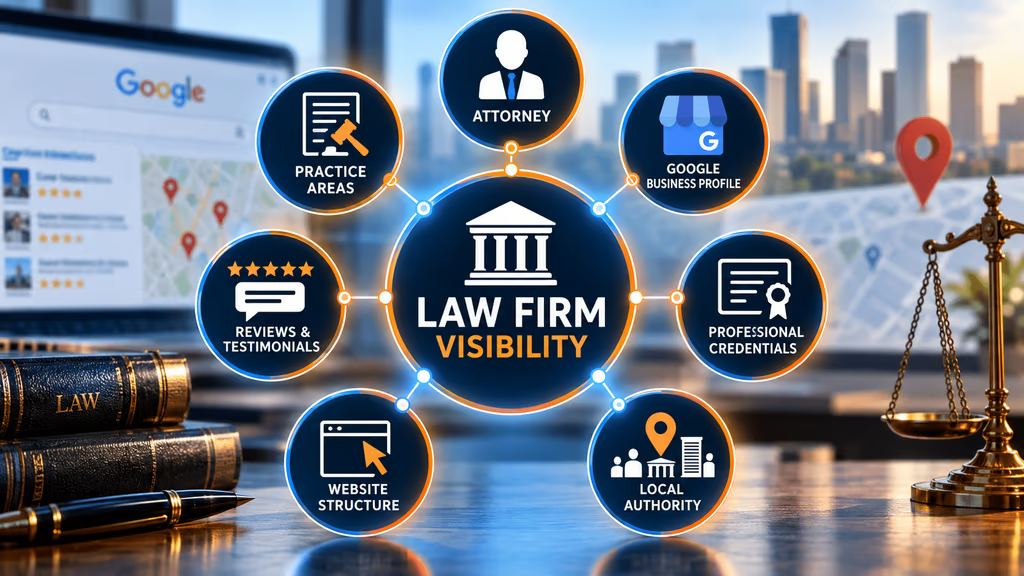
Law Firm SEO Is Usually an Alignment Problem Before It Is a Ranking Problem
Most law firms do not suffer from a complete lack of online presence.
They already have a website.
They may have dozens or hundreds of reviews.
Their attorneys have years of experience.
They may belong to professional organizations, appear in legal directories, publish useful content, and maintain an active Google Business Profile.
The problem is that those signals do not always reinforce each other.
Google may see:
- Practice areas described differently across the website and Google Business Profile
- Service pages that do not clearly connect the attorney, location, and legal service
- Strong reviews but weak website trust signals
- Old directories containing outdated information
- Geographic pages that add locations without adding meaningful local relevance
- Multiple strong signals that are never clearly connected
That creates ambiguity.
Our first objective is not simply to “do more SEO.”
It is to determine what Google currently understands about the law firm.
Consultant’s Read
A respected law firm can still look unclear online.
The attorney may be established. The reputation may be excellent. The practice areas may be obvious to existing clients.
But Google can only work with the signals it can identify, connect, and corroborate.
That is why we start with signal alignment before expansion.
How Google Evaluates Local Visibility
Google says local results are primarily based on three broad factors:
Relevance — how well the business matches what someone is searching for.
Distance — how far the business is from the location associated with the search.
Prominence — how well known and established the business appears to be.
Google also uses information from across the web, including websites, links, reviews, directories, and other sources, when evaluating local businesses.
For attorneys, that means visibility cannot be reduced to one keyword, one page, or one Google Business Profile setting.
The stronger question is:
Do the firm’s website, attorney information, practice areas, location signals, reviews, and outside references support the same understanding of the business?
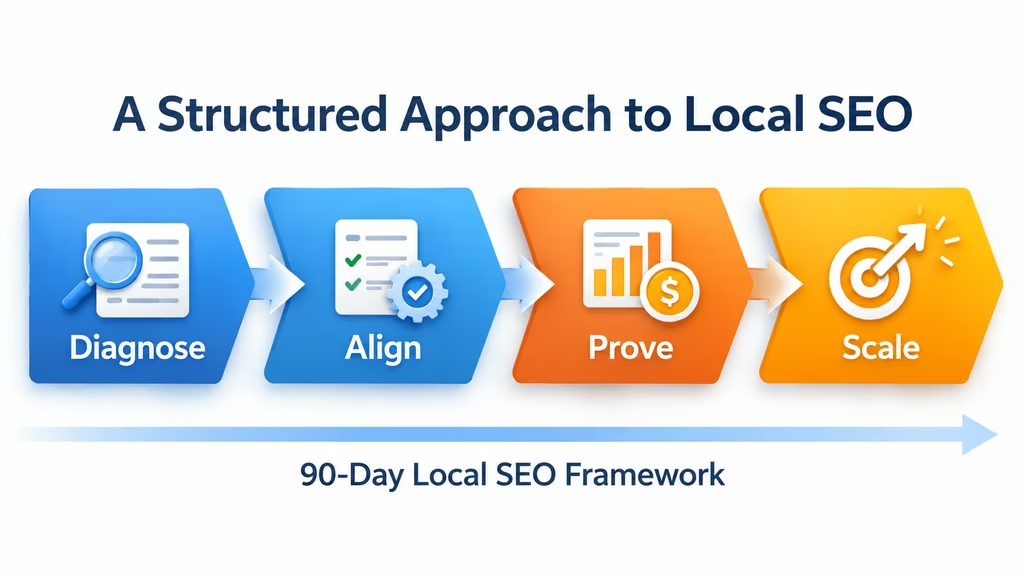
Our Local SEO Framework for Law Firms
We use the same four-stage framework we apply to other local businesses, adapted to the legal market.
Diagnose
We review what Google can currently see.
That includes:
- Website structure
- Practice-area pages
- Attorney biographies
- Google Business Profile
- Reviews and testimonials
- Local citations
- Professional profiles
- Internal linking
- Service and location relationships
- Technical visibility issues
The goal is to identify contradictions, missing signals, and areas where Google may be receiving an incomplete picture.
Align
Next, we bring the major visibility signals into agreement.
That may include:
- Matching practice-area terminology across the website and GBP
- Clarifying attorney-to-service relationships
- Improving location and service-area signals
- Strengthening internal linking
- Correcting inconsistent business information
- Connecting attorney biographies to relevant practice areas
- Improving Google Business Profile services and categories
- Tightening page titles, headings, and on-page context
Alignment often produces more value than simply publishing more content.
Prove
Once the basic signals are aligned, we strengthen corroborating evidence.
That may include:
- Client reviews
- Testimonials
- Professional memberships
- Bar profiles
- Local organizations
- Relevant directories
- Community references
- Legitimate links and mentions
- Helpful legal content demonstrating real subject knowledge
This is where reputation becomes part of the visibility picture.
Expand
Only after the foundation is clear do we look at expansion.
That may include:
- Additional practice-area content
- Geographic support pages
- Frequently asked questions
- Educational articles
- Supporting local content
- Internal-link expansion
- Google Business Profile content
- Additional authority-building opportunities
More pages are not automatically better.
Expansion should strengthen an already coherent signal structure.
SEO Services for Attorneys & Law Firms
The Attorney Trust Signals We Pay Attention To
For law firms, trust is not one badge or one ranking factor.
It is the cumulative effect of multiple signals.
Important examples include:
- Clearly identified attorneys
- Detailed attorney biographies
- Consistent business information
- Genuine reviews and testimonials
- Strong practice-area pages
- Google Business Profile alignment
- Professional credentials
- Local and professional affiliations
- Relevant outside mentions and links
- Clear contact and consultation information
We cover these in more detail in our guide:
7 Attorney Trust Signals That Influence Google Visibility
The central idea is simple:
Trust signals work best when they corroborate each other.
Google Business Profile Alignment for Attorneys
For many law firms, Google Maps visibility is one of the most important parts of local search.
A strong profile should accurately reflect:
- Primary business category
- Relevant secondary categories
- Practice areas and services
- Office information
- Website link
- Business hours
- Photos
- Reviews
- Firm description
- Contact information
But profile optimization should not happen in isolation.
The Google Business Profile should support the same practice areas, attorney identities, locations, and services users find on the website.
Google says complete and accurate business information helps it better understand a business and match it with relevant searches.
Learn more about our Google Business Profile Management and Optimization.
Practice-Area SEO Should Clarify, Not Multiply
Law firms often assume they need more pages.
Sometimes they do.
But a new page only helps when it makes the business easier to understand.
A useful practice-area page should explain:
- What type of matter the attorney handles
- Who the service is for
- Common situations that lead someone to seek help
- What the process may involve
- Related legal issues
- Questions clients frequently ask
- Geographic or jurisdictional context where appropriate
- What someone should do next
The goal is not to manufacture keyword pages.
It is to make legal expertise understandable to both prospective clients and search engines.
Practice Areas We Commonly Evaluate
Family Law SEO
Family law searches are highly local and trust-sensitive.
A strong family law presence usually requires clear separation of services such as divorce, child custody, child support, mediation, guardianship, and related matters.
The firm’s website, Google Business Profile, reviews, attorney biography, and geographic signals should all support those areas consistently.
Estate Planning SEO
Estate planning prospects often research before contacting an attorney.
Helpful content should explain services such as wills, trusts, powers of attorney, probate preparation, and related planning in plain language.
Strong attorney identity and trust signals matter because clients are often comparing several firms before making contact.
Criminal Defense SEO
Criminal defense searches can be urgent.
Service clarity, local relevance, Google Maps visibility, attorney credentials, and immediate contact information become especially important.
Real Estate Law SEO
Real estate law searches often involve specific transactions or disputes.
Pages should clearly distinguish the types of real estate matters handled rather than relying on one broad “real estate attorney” page.
Personal Injury SEO
Personal injury is among the most competitive legal search markets.
Clear practice-area positioning, strong reputation signals, local authority, technically sound pages, and Google Business Profile alignment all become important because competition for high-intent searches is intense.
A Real Example of Attorney Trust Signals Working Together


Penning Law PLLC provides a useful example.
The firm combines a clearly identified attorney, defined family-law practice areas, geographic coverage, professional memberships, a clearly explained client process, and more than 170 client testimonials.
No single one of those elements creates trust by itself.
Together, they create a much stronger body of corroborating evidence about the firm, its services, and its client experience.
Consultant’s Read
One testimonial is a claim.
A handful begins to show a pattern.
More than 170 creates a visible history of client experience.
That does not make testimonial count a standalone Google ranking factor.
It does, however, create substantial reputation evidence that supports the larger trust picture surrounding the firm.
Why Website Structure Matters to Attorney SEO
Google needs relationships to be clear.
For a law firm, those relationships often look like:
Attorney → Law Firm → Practice Area → Location → Supporting Content → Reputation
Internal linking helps reinforce those relationships.
For example:
A divorce page should naturally connect to:
- The family law section
- The attorney biography
- Mediation or custody pages where relevant
- Geographic service information
- Related educational articles
That produces a stronger information structure than a collection of disconnected practice-area pages.
What We Look for During a Law Firm Visibility Review
A review may include:
- Whether Google can clearly identify the firm
- Whether attorney identity is well established
- Practice-area clarity
- Google Business Profile alignment
- Local relevance
- Reviews and testimonials
- Reputation signals
- Professional affiliations
- Internal linking
- Website structure
- Location relationships
- Technical issues affecting crawlability
- Content gaps
- Competitive visibility patterns
The purpose is not to generate another giant SEO audit.
It is to determine:
What is unclear?
What already works?
What should be fixed first?
Attorney SEO Should Create Better Understanding Before More Traffic
Traffic by itself is not the objective.
The better outcome is visibility for searches that accurately reflect the services the firm wants to provide.
That requires clarity.
Google should be able to understand:
- Who the attorneys are
- What legal matters the firm handles
- Where the firm operates
- What clients say about the experience
- Which professional and local sources corroborate the firm
- How the major pages relate to each other
When those signals align, the firm has a stronger foundation for Maps visibility, organic visibility, branded search, and increasingly AI-assisted search experiences.
Frequently Asked Questions About Attorney SEO
What is local SEO for attorneys?
Local SEO for attorneys is the process of improving how clearly a law firm is represented across Google Search, Google Maps, its website, reviews, directories, and other local sources.
Does Google Business Profile matter for law firms?
Yes. A verified Google Business Profile helps law firms manage how their business information appears in Google Search and Maps, including contact information, location, reviews, photos, and other business details.
Do attorneys need separate pages for every practice area?
Not necessarily.
A separate page makes sense when the service has enough distinct client intent, information, and value to justify its own page. Thin or highly repetitive pages usually add little.
Do reviews influence local attorney visibility?
Google says review count and positive ratings are among the signals that can contribute to local prominence. Reviews also play an important role in helping potential clients evaluate a law firm.
Should law firms create city pages?
Only when the page provides legitimate geographic context and useful information.
Changing the city name while repeating essentially the same content across many pages is not a strong local strategy.
What should a law firm fix first?
Start with clarity.
Make sure attorney identity, practice areas, Google Business Profile information, location signals, reviews, and website structure all support the same understanding of the firm before expanding content.
Start With a Law Firm Visibility Review
If your law firm is not appearing consistently in Google Maps, local results, or important practice-area searches, the cause is rarely obvious from rankings alone.
Our Website Visibility Review looks at the website and Google Business Profile together to identify the signals that appear clear, the ones that conflict, and the areas worth investigating first.
No automated forty-page report.
No mystery SEO score.
Just a practical consultant-led review of what Google can see and where the firm may be sending mixed signals.
Start With a Free Website Visibility Review
(Powered by our Google Visibility Scorecard)
Call 442-340-3947 to discuss your situation directly.
Contact Web SEO Houston
Ethical and result-driven SEO for Attorneys and Law Firms.
Web SEO Houston
Kingwood, Texas 77339
442-340-3947