
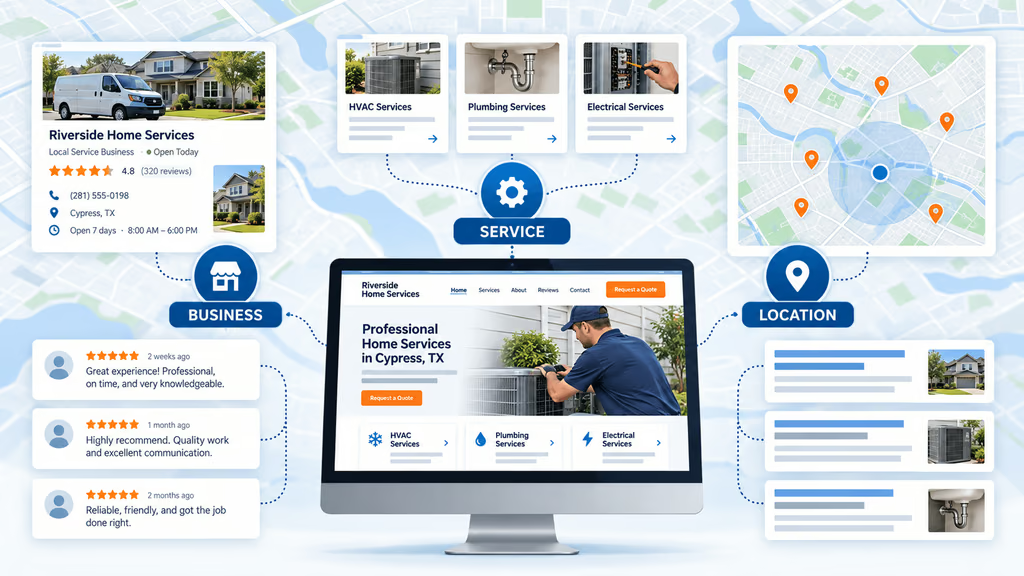
Local search optimization is the process of helping Google understand the relationship between your business, the services you provide, and the geographic markets you serve.
In practical terms, Google has to answer three questions:
Who is this business?
What does it do?
Where is it relevant?
When those relationships are clear across your website, Google Business Profile, service pages, reviews, and other local signals, your business becomes easier to match with relevant searches.
That is the real job of local search optimization.
It is not simply adding city names to pages, publishing more content, or filling out every field in a Google Business Profile.
It is making the relationship between your business, services, and geographic market clear enough for Google to understand when and where your business is relevant.
What Is Local Search Optimization?
Local search optimization is the process of improving the information and signals search engines use to connect a business with relevant searches in a specific geographic area.
Someone searching for:
- roof repair in Kingwood
- family attorney Humble TX
- AC replacement Atascocita
- remodeling contractor near me
isn’t just telling Google what they need.
They are also telling Google where they need it.
Google then has to determine which businesses appear relevant enough, close enough, established enough, and trustworthy enough to show.
That creates a relationship that looks something like this:
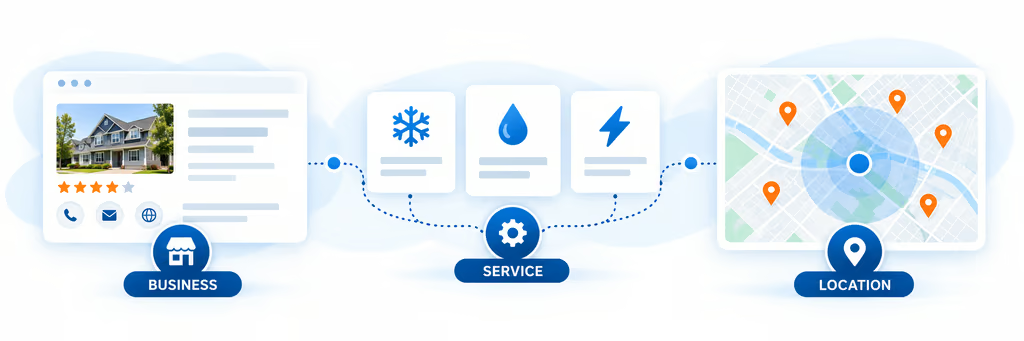
Business ↔ Service ↔ Location
The stronger and clearer those connections are, the easier the business is to understand.
Google Doesn't Learn About Your Business From One Page
A local business leaves information about itself all over the web.
- Google may find your services on your website.
- It may find your location or service territory in your Google Business Profile.
- It may learn what customers actually hire you for from reviews.
- It may find older business information in directories.
- It may see one city emphasized on your homepage and another emphasized throughout your service pages.
Individually, each piece may look harmless. Together, they create a picture of the business. And sometimes that picture is not nearly as clear as the business owner thinks it is.
Consider a simple example.
A contractor’s homepage says the company serves Kingwood, Humble, and Atascocita. Its Google Business Profile lists a much larger service area.
The company’s strongest service is roofing, but roofing is barely mentioned on the homepage.
Most customer reviews talk about remodeling. But, Several older directory listings still describe the company as a general contractor.
Which service should Google associate most strongly with that business?
Which market matters most?
That uncertainty is where local search optimization starts becoming more interesting than simply “using the right keywords.”
The Business, Service and Location Connection
It helps to think about local visibility as three connected pieces.
The Business
Google first needs to understand the actual entity behind the website.
That includes basic information such as the business name, contact information, Google Business Profile, website, reputation, and other independent references to the company.
But identity alone is not enough.
Google knowing that your business exists does not mean Google understands what it should rank for.
The Service
The next connection is what the business actually does.
Your important services should be easy to identify from your website structure, service pages, Google Business Profile, reviews, and supporting content.
A business that tries to emphasize everything equally can sometimes make its priorities less clear.
Your website should make it obvious which services matter most.
The Location
Finally, Google has to connect those services to a geographic market.
For a storefront, proximity can help establish that relationship.
For a business traveling to customers across several communities, the challenge becomes more complicated.
Simply typing twenty cities into a Google Business Profile does not create meaningful relevance in twenty cities.
There needs to be enough supporting information for Google to understand why the business belongs in those markets.
Local Search Problems Often Start With Conflicting Signals
Most businesses don’t intentionally send mixed messages.
They accumulate them.
- A website gets redesigned.
- Services change.
- A new location opens or closes.
- The Google Business Profile gets updated by someone else.
- Old directory listings remain online.
Pages get added over several years without anyone stepping back and looking at the complete structure.
Eventually, the website may say one thing while the Google Business Profile, reviews, citations, and service pages suggest something slightly different.
That does not necessarily mean Google will stop showing the business. But it can make the relationship between the business, its services, and its market less certain.
At Web SEO Houston, we call this Local SEO Signal Alignment.
Want to understand why conflicting signals matter? Read Local SEO Signal Alignment for a deeper look at how your website, Google Business Profile, services, reviews, locations, and supporting signals can either reinforce or contradict one another.
Local Search Optimization Is Not About Ranking Everywhere
This is especially important around Houston. Greater Houston is enormous.
A business may legitimately serve customers from Kingwood to The Woodlands, Humble, Atascocita, Spring, and communities much farther away.
That does not mean every one of those markets should receive equal SEO attention.
Trying to rank everywhere at once often produces thin city pages, vague geographic language, and a website that never establishes a strong relationship with any particular market.
A better question is:
Where does the business have the strongest real-world relationship?
That may be where the company is based.
It may be where most customers come from.
It may be where reviews, projects, referrals, and existing visibility are already strongest.
Strengthening that relationship first can create a much better foundation for expanding outward later.
Service-Area Businesses Have a Different Local Search Problem
Businesses without traditional walk-in traffic face an additional challenge.
An HVAC company, roofer, remodeler, tree service, mobile professional, or other service-area business may travel many miles to reach customers.
Google still has to determine how relevant that business is to someone searching from a particular location.
This is why adding a service area to a Google Business Profile does not automatically create strong visibility throughout that territory.
The website and surrounding signals need to help establish the connection.
That can include:
- Core service pages
- Useful service-area information
- Customer reviews
- Project examples
- Google Business Profile categories and services
- Internal links
- Local references
- Consistent business information
- Evidence of actual work performed in the market
The goal is not to make the business appear to have offices it does not have.
The goal is to accurately represent the territory it genuinely serves.
Operate without a storefront? Our Service-Area SEO guide explains why businesses that travel to customers face a different Maps and local visibility challenge.
More SEO Activity Is Not Always the Answer
When local visibility stalls, the natural reaction is often to add something.
- Another blog post.
- Another city page.
- More keywords.
- More citations.
- More links.
- More Google Business Profile posts.
Sometimes that is exactly what is needed. Sometimes it just adds another layer of information to a system that was already unclear.
Before adding more signals, it helps to understand the ones already there.
Which services does Google appear to associate with the business?
- Which pages are actually getting visibility?
- Where does Maps visibility begin to weaken?
- Does the Google Business Profile reinforce the website?
- Do reviews support the services the company is trying to grow?
- Are several pages competing to explain the same thing?
Diagnosis comes before expansion.
That is why our 90-day process follows:
Diagnose → Align → Prove → Expand
Want to see how we work through those problems? The 90-Day Local SEO Framework explains how we move from diagnosis to alignment, proof, and eventually expansion.
Good Local Search Optimization Makes a Business Easier to Understand
There is a temptation in SEO to make everything more complicated than it needs to be. Local search optimization works in the opposite direction.
The objective is clarity.
A person landing on your website should quickly understand:
- Who you are
- What you do
- Where you work
- Why they should believe you
- What they should do next
Search engines need many of those same answers.
Your website, Google Business Profile, service pages, location signals, customer reviews, and independent references should collectively reinforce them.
That does not mean every source has to contain exactly the same words.
It means they should describe the same real business.
Where Local Search Optimization Fits Into Local First SEO
Local search optimization is one piece of a larger strategy.
You can optimize individual pages, improve a Google Business Profile, correct citations, and strengthen service-area relevance.
But the strongest results tend to come when those individual actions are working toward the same business objective.
That is the thinking behind Local First SEO.
Instead of treating the website, Maps visibility, reviews, services, service areas, and supporting authority as separate projects, we look at how they reinforce one another.
The goal is not more SEO activity.
It is a clearer and more credible representation of the business wherever search engines and potential customers encounter it.
Want to understand the overall methodology? See how Local First SEO brings those pieces together.
The Simplest Way to Think About Local Search Optimization
Strip away the terminology and local search optimization comes back to three relationships:
Business ↔ Service
Does Google understand what you actually do?
Service ↔ Location
Does Google understand where those services are relevant?
Business ↔ Location
Is there enough evidence connecting your business with the market you want to serve?
Your website, Google Business Profile, reviews, service pages, local references, and real-world business activity help establish those connections.
The clearer the connections become, the easier it is for search engines to understand when your business is a relevant local result.
That is local search optimization.
Not ranking everywhere. Not adding more pages simply because you can.
Making the real business easier to understand.
See What Google Actually Sees
If your local visibility feels inconsistent, the problem may not be a lack of SEO activity.
It may be that your website, Google Business Profile, services, reviews, and service areas are telling slightly different stories.
A Free Website Visibility Review gives us a chance to look at the bigger picture together and identify the most obvious gaps affecting how your business appears in local search.
No generic SEO checklist. No pressure to buy anything.
Just a practical look at what Google can see, what may be unclear, and what deserves attention first.