
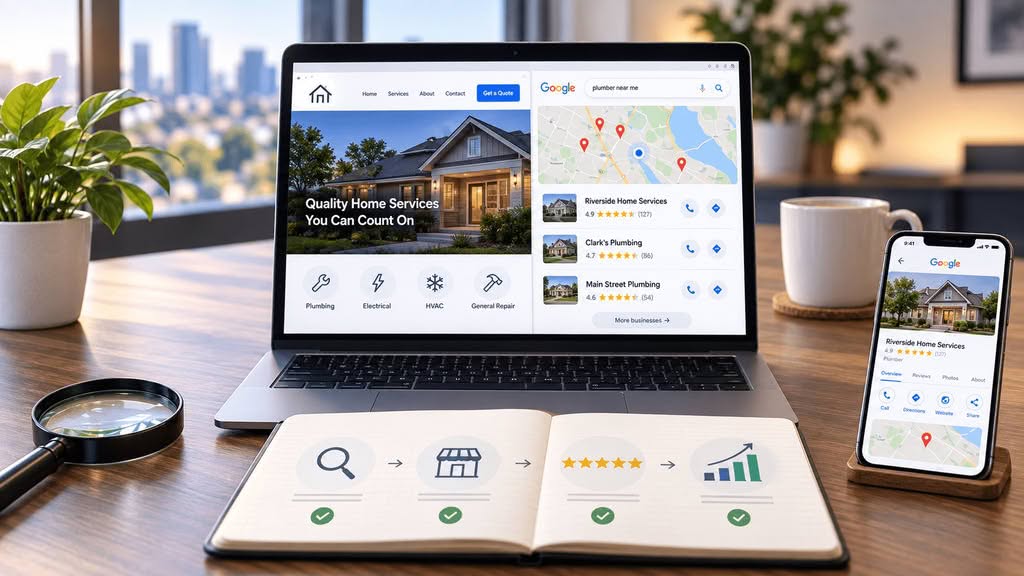
The 90-Day Local SEO Framework is the implementation process we use to identify what is holding back local visibility, strengthen the foundation, improve the signals Google depends on, and determine where continued SEO effort is most likely to produce better results.
Local SEO works better when the work happens in the right order.
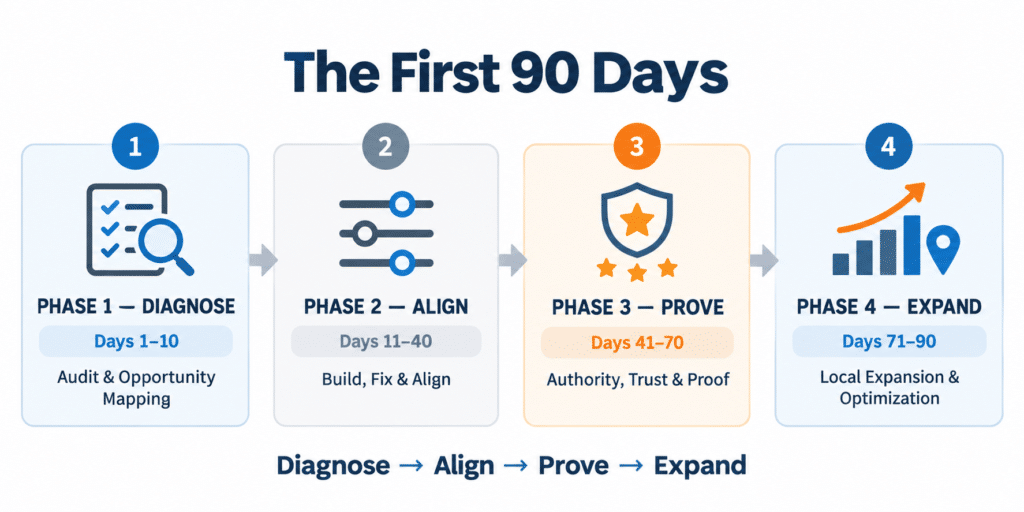
Rather than jumping from citations to content to Google Business Profile posts to technical fixes, the framework gives the first three months of Local SEO a defined sequence:
Diagnose → Align → Prove → Expand
Every business starts in a different place. The exact work may vary, but the framework gives us a clear way to determine what deserves attention first.
Why Local SEO Needs a Sequence
Local SEO is not one tactic.
Google is trying to understand several things at the same time:
- Who is this business?
- What services does it provide?
- Where does it provide them?
- Is the website consistent with the Google Business Profile?
- Does the business appear established and trustworthy?
- Are customers responding positively?
- Does the website clearly support the searches the business wants to compete for?
Problems occur when those signals do not agree.
A Google Business Profile may be well built while the website poorly explains the services. A website may have strong service pages but weak local trust signals. A company may have excellent reviews but confusing service areas. Technical problems can also prevent good content from performing as well as it should.
That is why we do not begin by assuming every business needs the same checklist.
We begin by finding the gaps. Then we work in sequence.
Our 90-Day Local SEO Framework
Every engagement follows the same strategic sequence: Diagnose → Align → Prove → Expand.
The work changes by business model. The order does not.
Phase 1 — DiagnoseDays 1–10: Audit & Opportunity Mapping
Before we start changing pages, adding content, or adjusting the Google Business Profile, we need to understand what Google currently sees.
The first phase establishes the starting point.
We review the business from both a search-engine and customer perspective to identify the strongest opportunities, obvious inconsistencies, and problems that may be limiting visibility.
Phase 1 may include:
- Website visibility review
- Google Business Profile review
- Core service alignment
- Service-area or location review
- Search visibility benchmarking
- Competitor visibility review
- Technical SEO checks
- Website structure and internal linking review
- Title tag and meta description review
- Review profile and reputation signals
- Citation and directory consistency
- Conversion-path review
- Analytics and tracking verification
We are not trying to produce the longest possible audit.
We are trying to answer a much more useful question:
What is most likely holding this business back right now?
The Consultant’s Read
Not every issue deserves immediate attention. Phase 1 separates problems that need to be addressed now from items that can wait until the foundation is stronger.
That becomes the working roadmap for the next 80 days.
Phase 2 — Align
Days 11–40: Build, Fix & Align
Once we understand the gaps, we begin bringing the major Local SEO signals into alignment.
This is often where some of the most important foundational work happens.
Google should be able to clearly understand the business, its services, where those services are available, and how the website relates to the Google Business Profile.
Phase 2 may include:
- Google Business Profile optimization
- Primary and secondary category review
- Service and product optimization
- Business description refinement
- Service-area configuration review
- Homepage local-intent alignment
- Location or service-area page improvements
- Internal linking
- Technical SEO priorities
- Structured data and schema review
- Form and conversion-path recommendations
- Citation cleanup or corrections
- Analytics and conversion tracking
This phase is about creating consistency.
Your website should not describe the business one way while your Google Business Profile describes it another.
Your primary services should be easy for both Google and customers to understand.
Your important service areas should be clear without creating dozens of thin city pages.
And visitors should have an obvious next step when they are ready to call, request information, schedule an appointment, or ask for an estimate.
Alignment Before Expansion
More pages, more citations, more posts, and more content are not automatically better.
If the underlying signals are unclear, creating more of them can simply create more inconsistency.
We align the foundation before we expand it.
Phase 3 — Prove
Days 41–70: Authority, Trust & Proof
Once the foundation is clearer, we strengthen the signals that help support credibility and local prominence.
Google does not rely only on what a business says about itself.
It also looks for supporting evidence.
Customers do the same thing.
They look at reviews, photos, website quality, experience, local mentions, helpful content, and whether the company appears active and established.
Phase 3 may include:
- Review acquisition strategy
- Review-response guidance
- Google Business Profile content
- Photo and media recommendations
- Local citation development
- Local authority opportunities
- Supporting service content
- Frequently asked questions
- Helpful educational content
- Brand trust signals
- Experience and expertise signals
- Project, case study, or portfolio opportunities
- Community and local-reference opportunities
- Website credibility improvements
The objective is not to manufacture authority.
It is to make the business’s real experience, reputation, services, and local presence easier for Google and prospective customers to recognize.
Trust Is Built Across the Entire Search Experience
A customer may first see your company in Google Maps.
Then they may read reviews.
Then they may visit the website.
Then they may return to Google and compare another company.
Local visibility works best when those touchpoints reinforce each other.
Phase 4 — Expand
Days 71–90: Local Expansion & Optimization
By this point, we have more than assumptions.
We have approximately two months of new information about how Google and customers are responding to the changes.
That gives us a better basis for deciding what deserves additional investment.
Phase 4 may include:
- Search visibility comparison
- Google Business Profile performance review
- Organic traffic review
- Lead and call data
- Conversion analysis
- Service-page performance
- Service-area visibility
- Search-query opportunities
- Content opportunities
- Internal-linking expansion
- Additional GBP optimization
- Local authority opportunities
- New service or location-page recommendations
This is where Local SEO becomes increasingly evidence-driven.
Instead of asking:
“What else can we do?”
we ask:
“What is working well enough to justify doing more?”
That distinction matters.
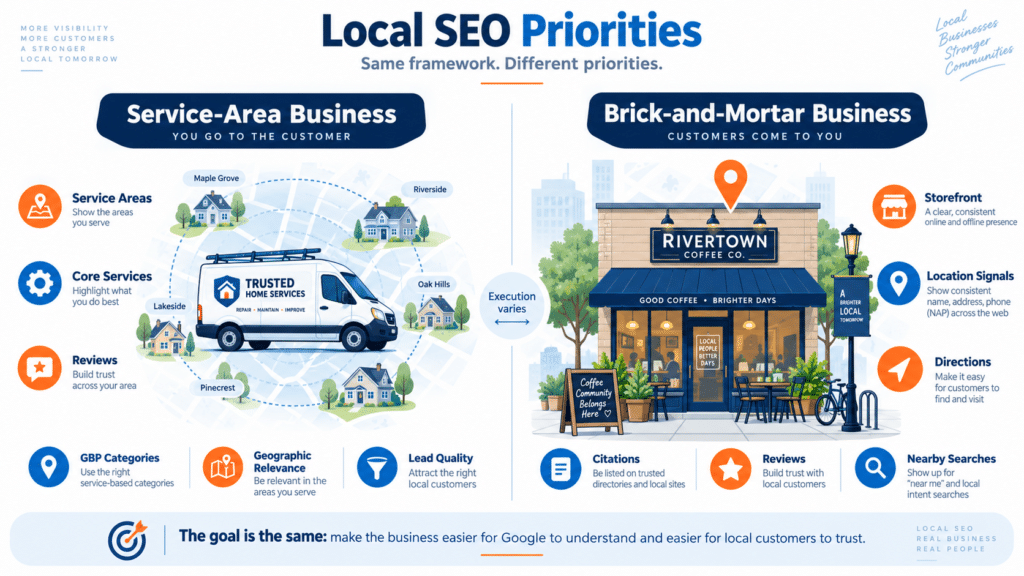
How the Framework Changes for Service-Area vs. Brick-and-Mortar Businesses
The four phases remain the same, but the Local SEO priorities can be very different.
Service-Area Businesses
Contractors, home-service companies, mobile professionals, consultants, and other service-area businesses often serve customers across multiple communities without operating public storefronts in each location.
For these businesses, we pay particular attention to:
- Google Business Profile service areas
- Primary service categories
- Website service-area clarity
- Core service pages
- Geographic relevance
- Local trust signals
- Reviews
- Calls and lead quality
- Whether location content is genuinely useful
- Avoiding thin or repetitive city pages
Service-area businesses still operate within Google’s geographic constraints.
Our goal is to strengthen relevance and prominence signals while making it very clear where the company actually works and what it does there.
Brick-and-Mortar Businesses
Businesses with a customer-facing location have a different set of Local SEO opportunities.
We may place greater emphasis on:
- Location-page optimization
- Accurate name, address, and phone information
- Local directories and citations
- Maps visibility
- Driving-direction searches
- Local reviews
- Photos and storefront signals
- Hours and business information
- Location-specific content
- Nearby searches and geographic relevance
For multi-location businesses, each legitimate location may require its own Local SEO strategy while still supporting the larger brand.
Same Framework. Different Priorities.
Execution varies. The objective stays the same: make the business easier for Google to understand and easier for local customers to trust.
What the First 90 Days May Include
First off; There is no universal Local SEO checklist that should be applied identically to every business.
The work is based on what we find during the diagnostic phase and what deserves priority.
Depending on the business, the first 90 days may include:
Google Business Profile
Categories, services, products, descriptions, service areas, photos, reviews, posts, Q&A, and profile consistency.
Website Optimization
Homepage alignment, service pages, location information, title tags, internal linking, schema, content improvements, and technical SEO priorities.
Local Trust & Authority
Reviews, citations, local mentions, brand signals, helpful content, experience, and community relevance.
Measurement & Conversion
Analytics, search visibility, calls, forms, lead quality, GBP activity, and conversion paths.
Content Opportunities
Supporting service content, FAQs, educational resources, location content, and search questions customers are already asking.
The exact work varies.
The sequence does not.
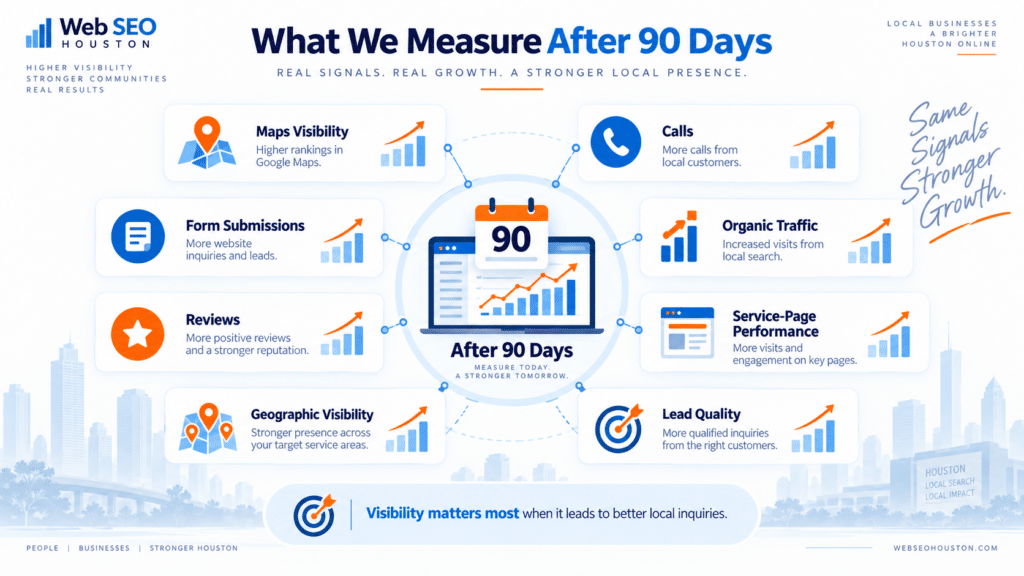
What We Measure
Rankings matter, but rankings alone do not tell us whether Local SEO is helping the business.
We look at a broader group of signals.
Depending on the program, that can include:
- Google Maps visibility
- Visibility for priority services
- Visibility in priority geographic areas
- Google Business Profile interactions
- Calls
- Appointment or estimate requests
- Service-page engagement
- Conversion rates
- Lead quality
- Services or locations showing new opportunity
The goal is to understand not only whether visibility changed, but whether that visibility is moving the business toward better customer inquiries.
What Clients Say About Working With Michael
What Happens After Day 90?
Day 90 is not an artificial finish line.
It is the point where we should have a much clearer understanding of the business’s Local SEO foundation, the changes that have been made, what Google is responding to, and where the strongest opportunities appear to be.
From there, depending upon your SEO contract, the next phase may involve:
- Continued Google Business Profile management
- Additional service-page development
- Content creation
- Expansion into additional service areas
- Local authority building
- Review growth
- Technical improvements
- Conversion improvements
- Competitive visibility work
- Ongoing search measurement and optimization
Some businesses need continued foundation work.
Others are ready to expand.
The important thing is that the next phase is based on what we learned during the first 90 days rather than on a predetermined list of monthly SEO chores.
Local SEO becomes more valuable when the strategy evolves with the evidence.
90-Day Local SEO Framework FAQs
What is the Web SEO Houston 90-Day Local SEO Framework?
The 90-Day Local SEO Framework is a four-phase Local SEO process built around Diagnose, Align, Prove, and Expand. It helps determine what is limiting local visibility, fixes foundational issues, strengthens local trust signals, and uses real performance data to guide the next stage of SEO.
Why does the framework last 90 days?
Ninety days provides enough time to review the existing Local SEO foundation, implement meaningful changes, allow search engines to process many of those changes, and begin evaluating performance. It is not a promise that every SEO objective will be achieved within 90 days.
Does every Local SEO client receive exactly the same work?
No. Every business starts with different strengths, problems, competitors, service areas, and goals. The framework stays consistent, but the specific work is based on what the initial diagnostic review identifies.
Does the framework include Google Business Profile optimization?
Google Business Profile optimization is often an important part of the framework. Depending on what we find, work may include categories, services, service areas, descriptions, photos, reviews, products, posts, Q&A, and alignment between the profile and website.
Is the framework designed for service-area businesses?
Yes. The framework is especially useful for contractors, home-service companies, professional service providers, and other service-area businesses that need to establish strong service and geographic relevance without relying on multiple storefront locations.
Does Local SEO work differently for brick-and-mortar businesses?
The underlying principles are similar, but priorities can differ. Brick-and-mortar businesses may rely more heavily on physical-location signals, citations, storefront information, Maps visibility, driving-direction searches, local reviews, and location-specific website content.
Will I rank #1 after 90 days?
No legitimate Local SEO process can guarantee a specific ranking position. Search results depend on factors including competition, location, relevance, prominence, the condition of the existing website and Google Business Profile, and Google’s own ranking systems.
The purpose of the framework is to build a stronger Local SEO foundation and identify where continued effort is most likely to improve visibility and lead generation.
What happens after the first 90 days?
At the end of the first 90 days, we review what changed, what is gaining traction, where gaps remain, and what opportunities deserve continued investment. That may lead to ongoing optimization, GBP management, new content, additional service-area development, technical work, or other Local SEO priorities.
How do I know whether my business needs the full 90-Day Framework?
Start with a Website Visibility Review.
We will look at how clearly your website communicates your business, services, location or service areas, trust signals, and local search intent. That gives us a better idea of where the biggest opportunities may be before discussing a larger Local SEO program.
Not Sure Where Your Local Visibility Is Breaking Down?
Start With a Free Website Visibility Review
You do not need to diagnose your own SEO before talking with us.
Our Free Website Visibility Review takes a practical first look at how Google and potential customers may be seeing your business online.
We look for questions such as:
- Can Google clearly understand what the business does?
- Are your primary services obvious?
- Are your service areas or location signals clear?
- Does the website support local search intent?
- Are important trust signals missing?
- Are there obvious Google Business Profile alignment issues?
- Is the biggest problem likely technical, content-related, local, or trust-related?
- What should probably be addressed first?
There is no automated 100-page SEO report and no obligation to hire us.
It is simply a practical starting point.
Location is everything
If your business is local you require local experts. Our entire team Lives, Works and Plays in the Houston area.