Local SEO isn’t just about adding the right keywords to a website or completing a Google Business Profile.
It is about making sure the important signals surrounding a business tell the same story.
Your website may say you are a roofing contractor serving Kingwood and Humble. Your Google Business Profile may describe you differently. Your service pages may emphasize Houston. Your business listings may contain an old address or phone number. Reviews may talk about services that barely appear on the website.
Individually, none of those issues may look serious.
Together, they can create uncertainty.
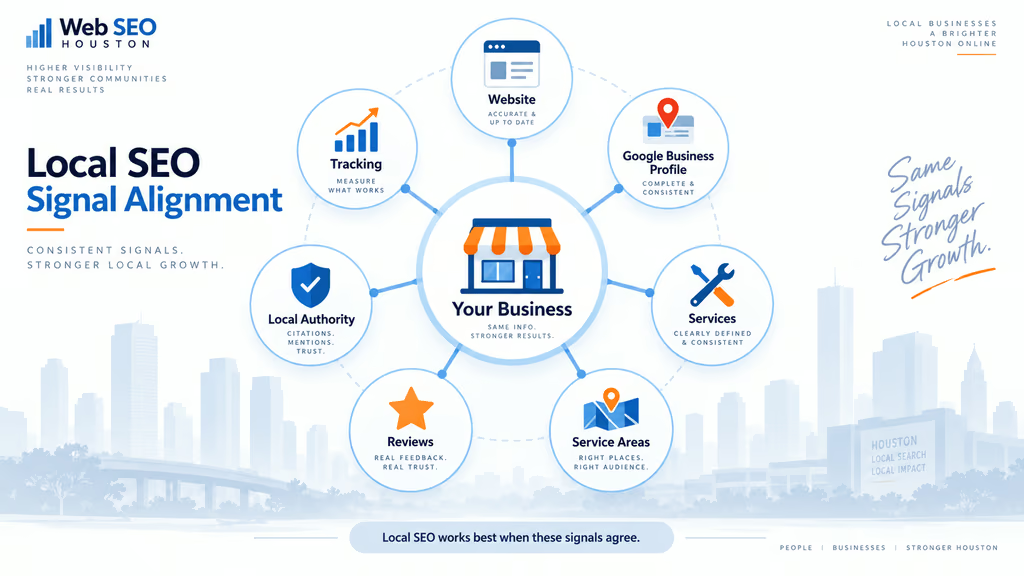
Local SEO Signal Alignment is the process of making your website, Google Business Profile, services, service areas, business information, reviews, and supporting local signals reinforce the same clear picture of who you are, what you do, and where you do it.
What are Local SEO Signals?
A local business leaves information about itself in many places.
Some of the most important signals include:
- Your business name and contact information
- Google Business Profile categories
- Products and services listed in your Google Business Profile
- Website service pages
- Geographic areas mentioned on the website
- Location or service-area pages
- Reviews and customer language
- Business directories and citations
- Internal website links
- Page titles and headings
- LocalBusiness and Organization structured data
- Links and mentions from other websites
These signals don’t operate as isolated checkboxes.
Google has to interpret them together.
The stronger the agreement between those signals, the easier it becomes to understand the relationship between your business, services, locations, reputation, and the searches you want to appear for.
The Problem Isn't Always Missing SEO
One of the first mistakes we see in local SEO is assuming a business simply needs more.
- More content.
- More city pages.
- More keywords.
- More backlinks.
- More Google Business Profile posts.
Sometimes the real problem isn’t a lack of signals. It’s that the signals already there don’t agree.
Imagine a service-area business that wants more air-conditioning repair work in Kingwood.
The homepage primarily talks about Houston.
The Google Business Profile uses a broad HVAC category but barely mentions repair services.
The air-conditioning repair page doesn’t mention Kingwood.
Several old directory listings use a previous phone number.
Most customer reviews talk about furnace installations.
Publishing another 1,500-word article about air-conditioning repair may not solve the underlying problem.
Before adding more SEO signals, it often makes sense to align the signals you already have.
Website and Google Business Profile Alignment
For most local businesses, the website and Google Business Profile should reinforce one another.
That doesn’t mean copying the same text from one platform to another.
It means making the underlying business information consistent.
If an important service appears prominently in the Google Business Profile, visitors should be able to find meaningful information about that service on the website.
If the website claims the company serves Kingwood, Humble, Atascocita, and The Woodlands, the overall local strategy should support those service areas realistically.
If a business describes itself as a residential roofing contractor on the website but its Google Business Profile, categories, services, and customer reviews mostly communicate general construction, there may be an alignment problem.
Google’s guidance for local businesses emphasizes complete and accurate business information because it helps Google better understand the business and match it with relevant searches.
The objective isn’t repetition.
It’s clarity.
Service Alignment Matters Too
Local SEO alignment goes deeper than your company name, address, and phone number.
Google also needs to understand what the business actually does.
That means important services should have a logical presence across the site.
A strong service often has several supporting signals:
Website: A useful page explaining the service.
Google Business Profile: The appropriate category and service information.
Internal links: Other relevant pages point naturally toward the service page.
Reviews: Real customers may mention the service when describing their experience.
Local context: The website makes it clear where the service is available.
Structured information: Where appropriate, schema helps search engines interpret the business and page content.
Google specifically supports LocalBusiness structured data as a way to provide machine-readable information about a local business.
No single item guarantees rankings.
The value comes from the combined picture.
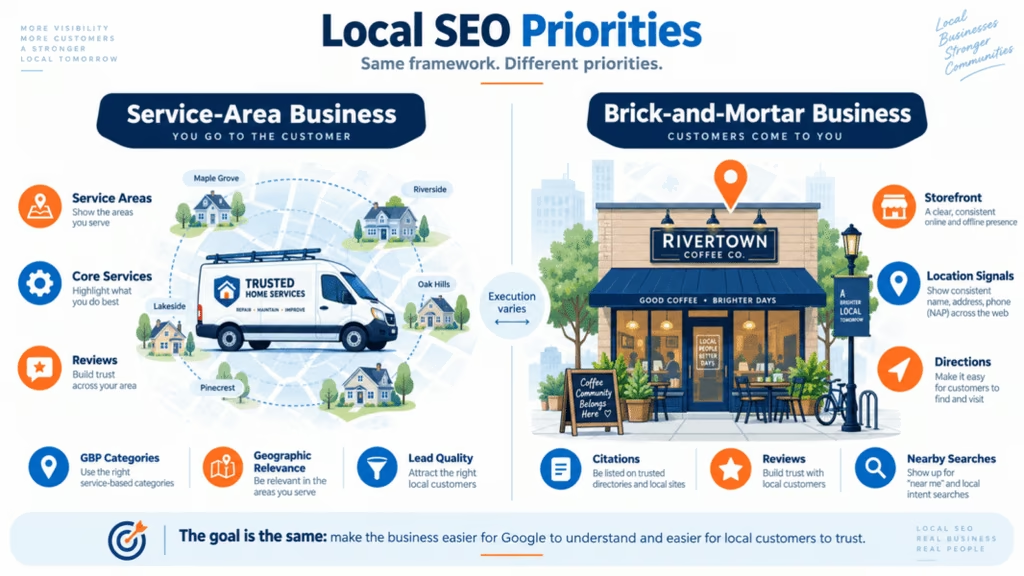
Service-Area Businesses Have an Extra Alignment Challenge
Service-area businesses don’t always have a storefront customers visit.
That makes geographic clarity even more important.
A plumber, roofer, HVAC company, remodeler, consultant, mobile service provider, or other service-area business may serve dozens of communities from one operating location.
The goal isn’t to mention every city everywhere.
It is to establish a believable relationship between:
Business → Service → Service Area
For example:
ABC Roofing → Roof Replacement → Kingwood
Then:
ABC Roofing → Storm Damage Repair → Humble
Then:
ABC Roofing → Roof Inspection → Atascocita
Those relationships should develop naturally through the website architecture, service content, Google Business Profile, reviews, local references, and actual business activity.
Simply producing dozens of near-identical city pages does not create meaningful local alignment.
Alignment Before Expansion
This is one reason our Local SEO process begins with diagnosis rather than content production.
Before expanding visibility, we want to know what Google can already see.
We look for questions such as:
- Does Google clearly understand the business?
- Are the primary services obvious?
- Do the website and Google Business Profile reinforce each other?
- Are the intended service areas clear?
- Are there conflicting business details?
- Are important services buried?
- Are local trust signals present?
- Is the existing website supporting the searches the business actually wants?
Only after those questions are answered does expansion make sense.
Otherwise, a business can spend months creating new content while continuing to amplify an unclear foundation.
A Simple Way to Think About Local SEO Signal Alignment
Think of local SEO as a collection of evidence.
One signal says:
This is who we are.
Another says:
This is what we do.
Another says:
This is where we do it.
Reviews provide evidence that customers actually use those services. Links, citations, and mentions help establish that the business exists beyond its own website. The website connects those pieces into an understandable structure.
Your Google Business Profile connects the business directly to Google’s local search ecosystem. When those signals support each other, Google receives a clearer picture. When they conflict, Google has more interpretation to do.
That’s why we don’t begin a Local SEO campaign by asking:
“How much content can we publish?”
We begin by asking:
“What does Google currently believe about this business?”
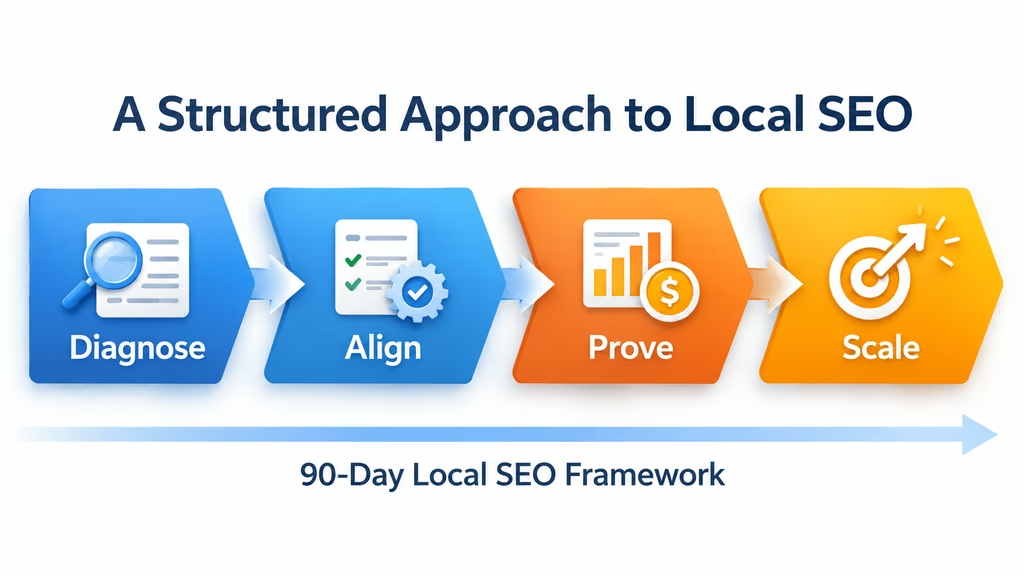
Diagnose. Align. Prove. Expand.
Local SEO Signal Alignment sits at the center of the Web SEO Houston 90-Day Local SEO Framework.
Our process follows four stages:
Diagnose
Identify what Google can currently understand about the business, services, service areas, website, and Google Business Profile.
Align
Bring the strongest business, service, geographic, website, and profile signals into agreement.
Prove
Strengthen those claims with reviews, citations, supporting content, authority, and real-world evidence.
Expand
Build outward into additional services, locations, questions, content opportunities, and search visibility after the foundation is strong.
The objective isn’t to manipulate Google with more signals.
It’s to give Google clearer, more consistent signals it can connect across the business, services, and service areas.
Want to See How the Entire Process Fits Together?
Read our 90-Day Local SEO Framework for Houston Businesses to see how we use Diagnose → Align → Prove → Expand to build a stronger local search foundation.
If you’re unsure where your own signals are breaking down, start with our Free Website Visibility Review.
We’ll take a practical look at what Google can see, where the story becomes unclear, and which problems deserve attention first.