
How Google Business Profiles Drive Maps, Calls, and AI Recommendations
Google Business Profile is the primary local trust signal Google uses to validate business entities across Maps, AI Overviews, and local search results. Google evaluates GBP data to confirm legitimacy, service scope, customer sentiment, and real-world engagement before assigning local visibility. A properly optimized profile influences whether a business is eligible to be surfaced at all.
Executive Overview
Google Business Profile is no longer just a local listing.
It is the primary trust and validation layer Google uses to decide which local businesses appear in Maps, surface in AI Overviews, and receive real customer calls.
As search has shifted toward AI-driven answers and recommendations, Google Business Profiles now act as a local authority signal — helping Google understand who your business is, what it offers, and whether it is safe to recommend.
This page explains how Google Business Profiles actually influence local visibility today, why many profiles stall despite “being optimized,” and how proper GBP alignment fits into a modern AI-first local SEO strategy.
For an in-depth “How-To Guide” on GBP Optimization we suggest this Build a Better Google Business Profile article.
.
Why Google Business Profile Is the Driving Force Behind the Map Pack
It is impossible to talk about the Google Map Pack without first addressing Google Business Profile.
All Map Pack listings are anchored to a GBP.
Every local AI recommendation references GBP data.
Every local call begins with trust signals tied to a profile.
Google does not rank Map Pack results the same way it ranks websites.
Instead, it evaluates local trust, relevance, and behavioral confidence — much of which originates from your Google Business Profile.
In practice, this means:
- Strong websites can still underperform locally
- Newer businesses can outrank older competitors
- Map Pack visibility can fluctuate even without website changes
The deciding factor is often GBP alignment, not traditional SEO.
From Google’s perspective, Map Pack visibility is not a ranking problem — it is a decision problem.
The system weighs trust, relevance, and proximity signals sourced largely from Google Business Profile data, then decides which businesses meet the threshold to appear.
Suggest Read: How to Dominate the Google Map Pack
How Google Evaluates a Google Business Profile
Google Business Profiles are evaluated as entities, not static listings.
AI systems compare GBP data against websites, citations, reviews, and user behavior to determine whether a business is credible enough to surface — and safe enough to recommend.
1. Entity Accuracy & Consistency
Google cross-checks your business name, address, phone number, categories, services, and website against other sources.
Conflicting signals reduce confidence.
Clean, consistent signals reinforce trust.
2. Relevance to Search Intent
GBP categories, services, and descriptions help Google determine when your business should appear.
Misaligned categories or vague service definitions often suppress visibility — even if everything else looks correct.
3. Review Quality, Velocity, and Sentiment
Reviews are not just social proof. They are behavioral trust data.
Google evaluates:
- Review frequency (velocity)
- Language patterns and sentiment
- Owner responses and engagement
- Signals of authenticity
A high rating alone is not enough.
4. Behavioral Signals
Google monitors how users interact with your profile:
- Calls
- Direction requests
- Website clicks
- Photo engagement
These signals help Google validate real-world relevance.
5. Profile Activity & Freshness
Regular updates signal operational legitimacy.
This includes:
- Posts
- Photos
- Service updates
- Attribute changes
Dormant profiles tend to lose momentum over time.
How AI Uses Google Business Profile Data
AI-driven systems inside Google do not “rank” Google Business Profiles in isolation. They evaluate GBP data as part of a broader decision model designed to answer one question:
Is this business a reliable and relevant recommendation for this search?
To answer that, AI systems use Google Business Profile data to:
- Validate the business as a real-world entity
- Confirm service relevance to the query
- Measure trust through customer behavior and reviews
- Assess operational legitimacy and activity
When these signals align, visibility increases. When they conflict, exposure is quietly reduced.
Why Many GBP “Optimizations” Stall
Most Google Business Profiles are not failing — they are misaligned.
Common issues we see:
- Over-optimized descriptions written for keywords, not clarity
- Incorrect or competing primary categories
- Service lists that don’t match real customer intent
- Review strategies focused on volume, not trust
- Posting activity that adds noise instead of relevance
- Profiles treated as standalone assets instead of part of a system
These issues don’t always cause penalties — they quietly limit visibility.
What Google Business Profile Optimization Is Not
It is not:
- Filling out every field
- Posting frequently without strategy
- Chasing keywords in descriptions
- Treating GBP as a standalone asset
Optimization succeeds when profile data reinforces trust and relevance across Google’s ecosystem — not when it is optimized in isolation.
Google Business Profile in the AI Search Era
AI Overviews, voice search, and generative results rely heavily on trusted local data sources.
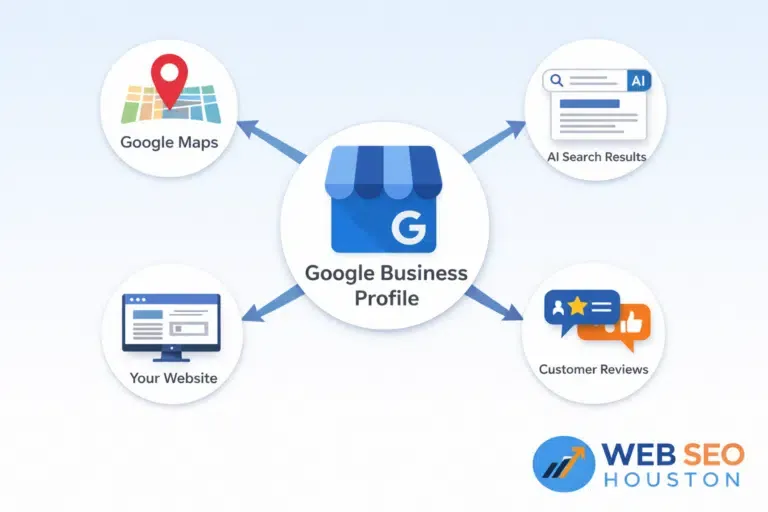
Your Google Business Profile feeds:
- Google Maps
- Local AI recommendations
- Voice assistants
- Brand validation inside AI summaries
From Google’s perspective, your GBP helps answer:
- Is this business legitimate?
- Are they active?
- Is it relevant to this query?
- Is it safe to recommend?
This makes GBP optimization foundational – not optional – for modern local visibility.
Our Google Business Profile Optimization Approach
Our approach focuses on alignment, not surface-level optimization.
We treat your Google Business Profile as a local trust asset that must align with:
- Your website
- Your services
- Your reputation
- Your conversion goals
This includes:
- Entity and category alignment
- Service and intent clarity
- Review strategy focused on trust signals
- Profile activity that reinforces relevance
- Ongoing refinement based on visibility and engagement patterns
The goal is not just to appear — but to appear when it matters, to the right audience, with confidence.
How GBP Fits Into a Broader AI Search Alignment Strategy
Google Business Profile does not operate in isolation.
For sustained visibility, it must align with:
- Website content and entity signals
- Local SEO foundations
- Brand mentions and citations
- Conversion paths after discovery
When these elements work together, Google gains confidence — and confidence leads to visibility.
This is why GBP optimization works best as part of a coordinated local visibility strategy, not a one-time task.
Implementation Reality Check
Reading This Is Easy. Implementing It Is Not.
Google Business Profile optimization today requires more than filling out fields or posting occasionally.
Aligning your profile with Google’s AI-driven evaluation systems takes strategy, consistency, and ongoing refinement.
Most businesses choose to start with a structured analysis and roadmap before making changes.
Frequently Asked Questions
Is Google Business Profile still important for local SEO?
Yes — it is more important now than ever. GBP is the foundation of Map Pack visibility and local AI recommendations.
Can I rank in the Map Pack without optimizing my website?
A website helps, but Google Business Profile alignment is the primary driver of local visibility.
How often should a Google Business Profile be updated?
Profiles should be reviewed regularly and updated as services, hours, and customer behavior change.
Do posts and photos still matter?
Yes — but only when they reinforce relevance and legitimacy. Activity without strategy adds little value.
Is GBP optimization a one-time task?
No. Visibility is dynamic. Profiles require ongoing monitoring and refinement to stay aligned.