
How Businesses Become Understandable, Trusted, and Selectable in AI-Driven Search
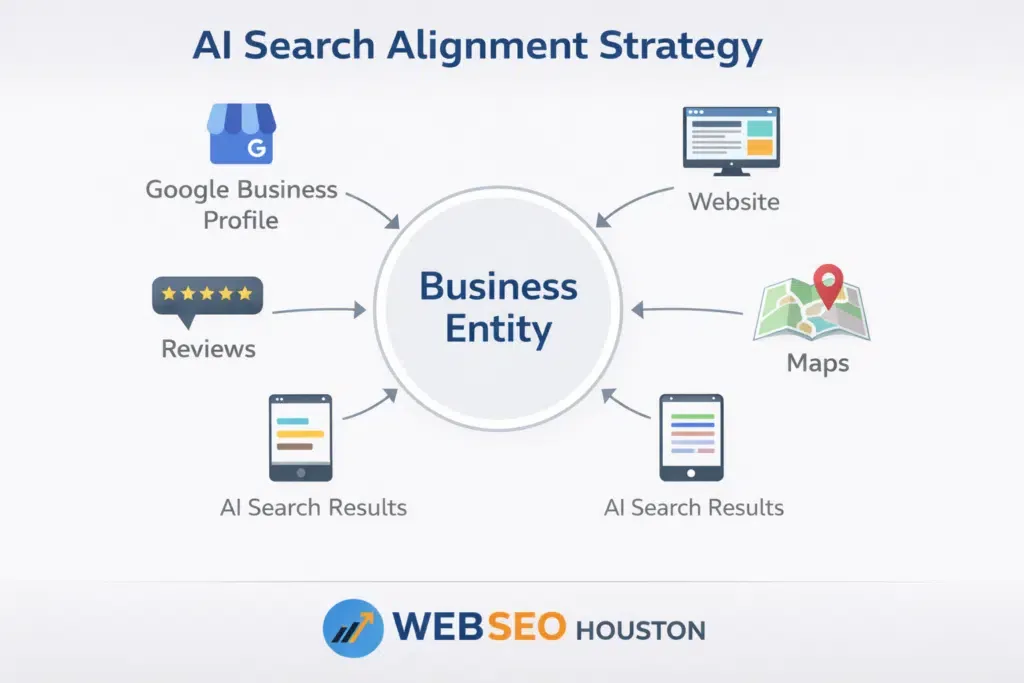
AI-driven search systems do not rank websites in isolation. They evaluate businesses as entities by analyzing trust, relevance, and real-world behavior across Google Business Profiles, websites, reviews, and brand signals. AI Search Alignment is the process of coordinating those signals so a business is eligible to be surfaced, cited, and recommended consistently.
What “AI Search Alignment” Actually Means
AI Search Alignment is not a tactic.
It is not a channel.
And it is not a replacement for SEO.
It is the strategic process of aligning how your business appears, behaves, and is validated across Google’s ecosystem so AI systems can confidently select it as a reliable answer or recommendation.
Modern search engines no longer ask:
“Which page ranks highest?”
They ask:
“Which business is trustworthy enough to recommend right now?”
Why Traditional SEO Alone Is No Longer Enough
Traditional SEO focuses on:
- Keywords
- Rankings
- Pages
AI-driven search focuses on:
- Entities
- Trust signals
- Contextual understanding
This is why many businesses experience:
- Stable rankings with declining clicks
- Higher ad costs with weaker lead quality
- Inconsistent Map Pack visibility
- AI Overviews that exclude their brand
The issue is rarely “bad SEO.”
It’s misalignment across systems AI relies on.
The Core Components of AI Search Alignment
AI Search Alignment works by coordinating five interdependent layers of visibility.
- Entity Clarity
AI systems must clearly understand:
- Who you are
- What you do
- Where you operate
Conflicting signals across your website, Google Business Profile, and citations reduce confidence and limit visibility.
- Trust & Reputation Signals
AI evaluates whether your business is safe to recommend by analyzing:
- Review quality and sentiment
- Engagement behavior
- Brand mentions and references
- Consistency over time
Trust is inferred — not claimed.
- Relevance & Intent Matching
AI systems prioritize businesses that match user intent, not just keywords.
This includes:
- Service clarity
- Category alignment
- Content that answers real questions
- Contextual relevance to local searches
- Behavioral Validation
User actions reinforce or weaken AI confidence.
Signals include:
- Calls
- Direction requests
- Clicks
- Engagement with profiles and content
Strong behavior validates relevance. Weak behavior creates hesitation.
- Conversion Integrity
Visibility without conversion creates false confidence.
Aligned businesses ensure that once AI surfaces them:
- The next step is obvious
- Trust signals are visible
- Users can act without friction
AI visibility is only valuable when it leads to real outcomes.
How AI Search Alignment Is Implemented (At a High Level)
AI Search Alignment is not implemented by “optimizing everything at once.”
It follows a diagnostic-first approach:
- Visibility Analysis
Identify how Google and AI systems currently interpret your business. - Signal Alignment Planning
Determine where entity clarity, trust, relevance, or behavior breaks down. - Coordinated Optimization
Align Google Business Profile, website content, reputation signals, and conversion paths. - Monitoring & Refinement
Adjust based on real-world engagement and visibility patterns.
This approach reduces risk and prevents guesswork.
Why Diagnosis Comes Before Execution
Most visibility problems are not obvious on the surface.
Businesses often:
- Optimize the wrong elements
- Chase rankings instead of trust
- Add content when alignment is the issue
- Make changes that increase volatility
Diagnosis ensures effort is focused on where it matters
Where the Google Visibility Scorecard Fits
The Google Visibility Scorecard is how AI Search Alignment begins.
It provides a structured snapshot of:
- How your business appears across search, Maps, and AI surfaces
- Where trust and relevance signals are strong or weak
- Which alignment gaps limit visibility
- What should be prioritized — and what should not
It is not a report for vanity metrics.
It is a decision tool.
Implementation Reality Check
AI Search Alignment is not difficult — but it is coordinated.
It requires:
- Clear diagnosis
- Strategic prioritization
- Consistency over time
Businesses that approach AI visibility systematically tend to gain:
- More stable local presence
- Better lead quality
- Reduced reliance on ads
- Compounding visibility rather than volatility
Next Step: See Your Current Alignment
Understanding AI Search Alignment conceptually is useful.
Seeing how it applies to your business is where clarity begins.