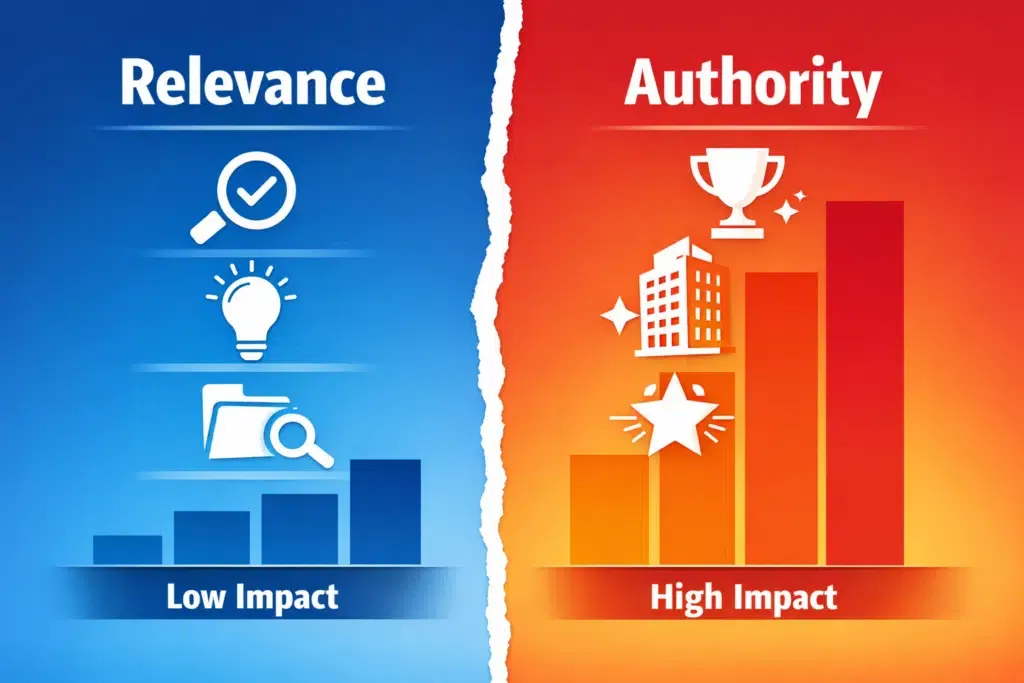
Is “Topical Relevance” in Backlinks Overrated?
Short answer:
Relevance helps establish what your site is about.
Authority is what usually moves rankings once you’re established.
That distinction matters.
Every few years, SEO circles elevate one concept to near-law status.
Right now, “topical relevance” in backlinks is treated as the deciding factor in link value.
It isn’t.
What Topical Relevance Actually Does
Topical relevance helps Google categorize your site.
If you sell supplements, a few health publications linking to you reinforces that context.
If you’re a SaaS platform, links from tech publications clarify positioning.
This is foundational.
Google needs enough signals to confidently understand your subject matter.
But that is a threshold requirement, not a scaling mechanism.
Once Google understands your site’s topic, relevance alone rarely drives meaningful ranking growth.
What Actually Changes Rankings
In most stalled SEO campaigns, the bottleneck is not relevance. It’s authority.
Authority comes from:
- High-trust domains
- Established publications
- Recognized brands
- Real-world partnerships
- Strong local institutions
A mention from a highly respected domain – even if not perfectly aligned with your niche – can dramatically improve perceived trust and link equity.
Think about this:
- A feature in Forbes
- A citation from Bloomberg
- A partnership listing from a major bank
- An integration mention from Shopify
Are those perfectly topically aligned? Not always.
Do they increase domain strength signals Google respects? Almost always.
Why This Feels Confusing
The reason many business owners believe relevance is the main driver is simple: It sounds logical.
“Health site links to health site” feels clean.
But Google evaluates:
- Domain authority
- Trust signals
- Link equity flow
- Broader web relationships
Not just topical alignment.
This misunderstanding is one reason SEO can feel unpredictable.
If you’ve ever wondered why rankings move even when you’re “doing everything right,” this ties directly into the broader issue explained here:
👉 Why SEO Feels Random
https://webseohouston.com/search-visibility-questions/why-seo-feels-random/
SEO rarely behaves randomly. It behaves according to signals most businesses aren’t measuring correctly.
For Local & Service-Area Businesses
This distinction is even more important for contractors, law firms, and other service-area businesses.
You do not need 50 niche industry blogs linking to you.
You need:
- Local authority citations
- Regional media mentions
- Chamber or business association links
- Trusted partnerships
- Strong Google Business Profile alignment
A respected local publication or institutional link often outweighs multiple small “relevant” blogs.
Because Google understands trust and geography.
The Better Question to Ask
Instead of asking:
“Is this site relevant to my niche?”
Ask:
“Does Google clearly trust this domain?”
That single shift changes link strategy from chasing topical purity to building real authority.
And authority compounds over time.
Topical Relevance vs Authority in Backlinks: What Actually Moves Rankings?
Consultant’s Read
“I rarely see rankings stuck because a site lacks perfectly relevant links.
More often, the site simply hasn’t earned enough trust from the broader web yet.”
Once Google understands what you do, the next step isn’t niche purity – it’s credibility. And credibility usually comes from stronger domains, not smaller ones that just happen to match your topic.
That shift changes how you think about links entirely.
Summary for Quick Extraction
- Topical relevance helps Google understand your topic.
- Authority determines how much ranking weight your links carry.
- Once a site is established, lack of power — not lack of relevance — is usually the bottleneck.
- For local businesses, regional authority often matters more than niche blogs.
If rankings feel stuck, the issue is usually signal strength — not topical precision.