AI Overview Visibility Is Structural, Not Tactical
Most conversations about AI SEO focus on optimization tactics.
Add schema.
Improve semantics.
Answer more questions.
Track performance.
That advice isn’t wrong.
It’s just incomplete.
AI systems don’t promote content because a checklist was followed.
They surface sources when structural confidence exists.
Before tactics matter, visibility conditions must be present.
Optimization Is Not Eligibility
Traditional SEO thinking centers on ranking improvements.
AI-driven search works differently.
Large language systems assemble answers from sources they:
• Understand clearly
• Trust structurally
• Recognize as consistent entities
If those conditions aren’t met, your business isn’t competing for AI visibility.
It’s filtered out before the conversation begins.
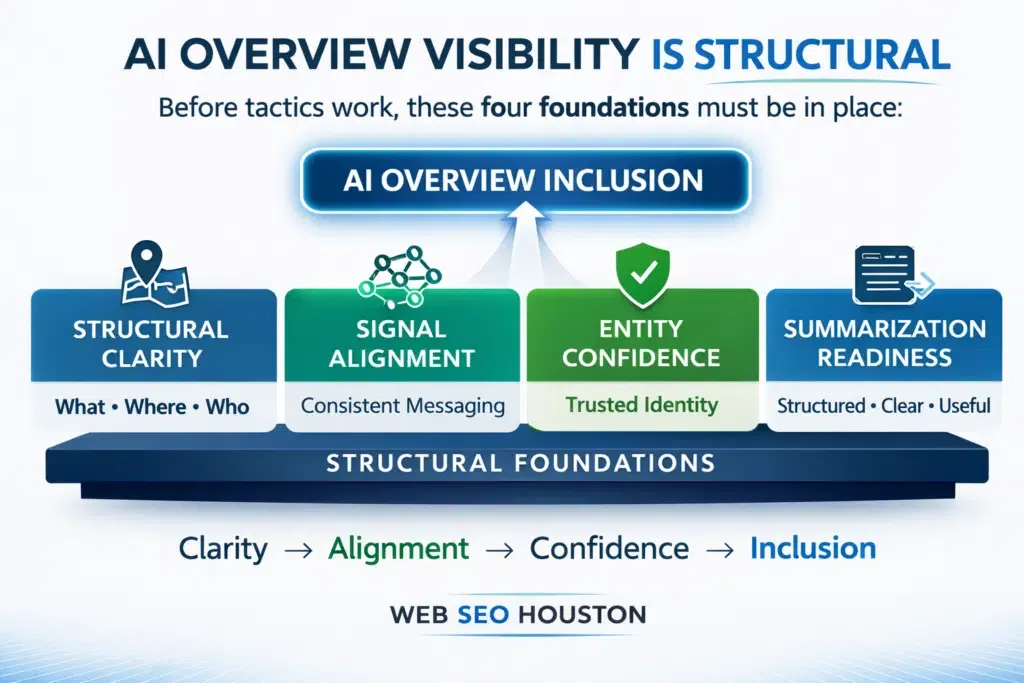
The Structural Conditions for AI Overview Inclusion
AI search visibility depends on foundations that most local businesses never examine.
1. Structural Clarity Search systems must quickly determine:
• What you do
• Where you operate
• Who you serve
If your service pages blur together…
If your geography is implied instead of defined…
If your positioning changes from page to page…
Confidence drops.
Ambiguity prevents summarization.
2. Signal Alignment
Your digital footprint must reinforce the same meaning everywhere:
• Website
• Google Business Profile
• Citations
• Brand mentions
When platforms describe a business differently, AI systems hesitate.
This is especially common with service-area businesses.
Mixed signals create entity uncertainty.
Entity uncertainty reduces inclusion.
3. Entity Confidence
AI search relies on entity-level trust, not page-level tricks.
Confidence builds when:
• Business naming is consistent
• Services are clearly defined
• Topical focus is tight
• Authority signals accumulate around one identity
When signals scatter across multiple specialties, names, or narratives, systems struggle to model the business accurately.
Clear entities are easier to summarize.
Vague entities are easier to ignore.
4. Summarization Readiness
AI Overviews compress information into answer formats.
Content that works well tends to be:
• Structured logically
• Written in explanatory language
• Organized by intent
• Free of promotional clutter
Dense marketing copy resists extraction.
Clear explanations enable inclusion.
If content can’t be cleanly summarized, it rarely gets cited.
Why “AI Optimization” Often Fails
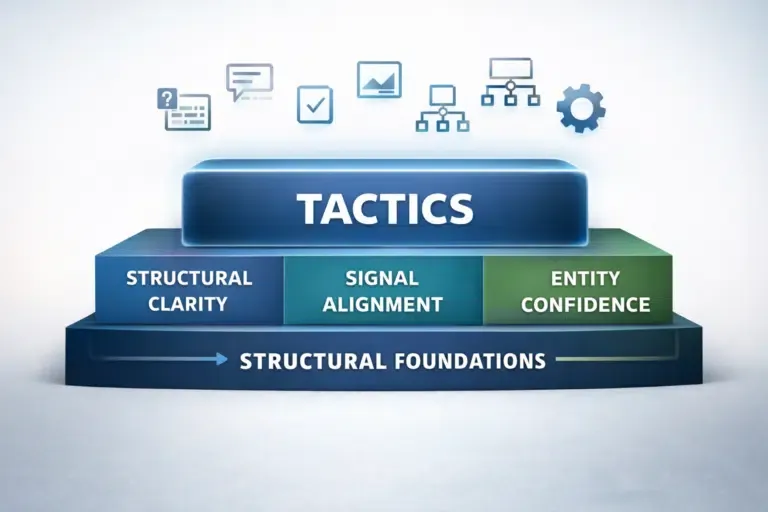
Most businesses try to optimize before they qualify.
They invest in:
• More content
• More keywords
• More tools
• More technical tweaks
But structural gaps remain.
Google may index the site.
Rankings may fluctuate.
Traffic may appear.
Yet AI systems still lack confidence.
Without structural readiness, optimization produces noise — not visibility.
Local Businesses Face an even Harder Reality
Service-area businesses deal with additional friction:
• No storefront anchor
• Broad geographic targets
• Overlapping service categories
• Competitive compression in Maps
Without strong structural signals, visibility shrinks quickly.
AI systems prefer clarity over coverage.
Precision beats volume.
Consultant’s Read
Most local businesses aren’t missing tactics.
They’re missing alignment.
When Google can’t confidently model what a business is, where it operates, and how it fits into a local ecosystem, AI systems avoid citing it.
That’s why visibility often feels unpredictable.
Structural clarity creates eligibility.
Alignment creates trust.
Trust creates inclusion.
Michael Klasno
Web SEO Houston
A Better Way to Think About AI SEO
Instead of asking:
“How do we optimize for AI search?”
Ask:
“Does Google have enough structural confidence to summarize us?”
That shift changes everything.
It moves the work from surface tactics to foundational visibility.
And that’s where durable advantage lives.
Where This Fits in a Local SEO Strategy
AI visibility isn’t separate from local SEO.
It’s the outcome of:
• Clear positioning
• Consistent signals
• Strong entity definition
• Intent-aligned content
When those elements align, inclusion becomes possible.
When they don’t, optimization efforts stall.
What this means to your business
Most business owners don’t realize where structural gaps exist until they look at their website and Google Business Profile side-by-side.
That’s exactly what we do in our Google Visibility Review.
In about 20 minutes we walk through:
• Website structure
• Google Business Profile alignment
• Local visibility signals
No audit. No pressure. Just clarity.